About Orgame/Argamum

My photo
Blog created and administrated by: Dr. Vasilica Lungu (excavation director of Orgame necropolis), Dr. Alexandra Dolea, Dr. Alina Mușat-Streinu and Dr. Marius Streinu. Orgame/Argamum is one of the most important archaeological sites along the Black Sea coast. The pattern of habitation for the area lasts, with small periods of interruption, almost two millennia. The archaeological discoveries fully illustrate this interval, starting about the 13th century and divided into the following periods: Bronze Age (13th century B.C); Early Iron Age (10th – 8th centuries B.C.); Archaic and Classical (7th – 4th centuries B.C.); Hellenistic (3rd – 2nd centuries B.C.); Early Roman (2nd – 4th centuries A.D.) and Late Roman (4th – 7th centuries A.D.).
Showing posts with label Orgame-Argamum. Show all posts

8/23/11

THE ORGAME NECROPOLIS. Excavation programme 2011

Archaeological excavations in the necropolis of ancient Orgame /Argamum started in 1988 and since then have been carried out annually with systematic research programmes headed from 1990 onwards by Dr. Vasilica Lungu (Institute of South East European Studies, Romanian Academy, Bucharest).

The archaeological evidence has revealed the presence of distinctive cremation graves with certain unusual features within the Greek necropolis. The cremations and cremation pits are usually marked by stone circles and covered over by tumuli which cluster within family plots. These are systematically distributed along ancient roads leading out of the city. They are accompanied by rich votive gifts, identified mainly by ceramic vessels as part of funerary deposits which offer a fairly complete notion of the structure of ancient society.

Such funerary practices continued over a long interval of time, from the second half of the 7th to the middle of the 3rd century BC. 

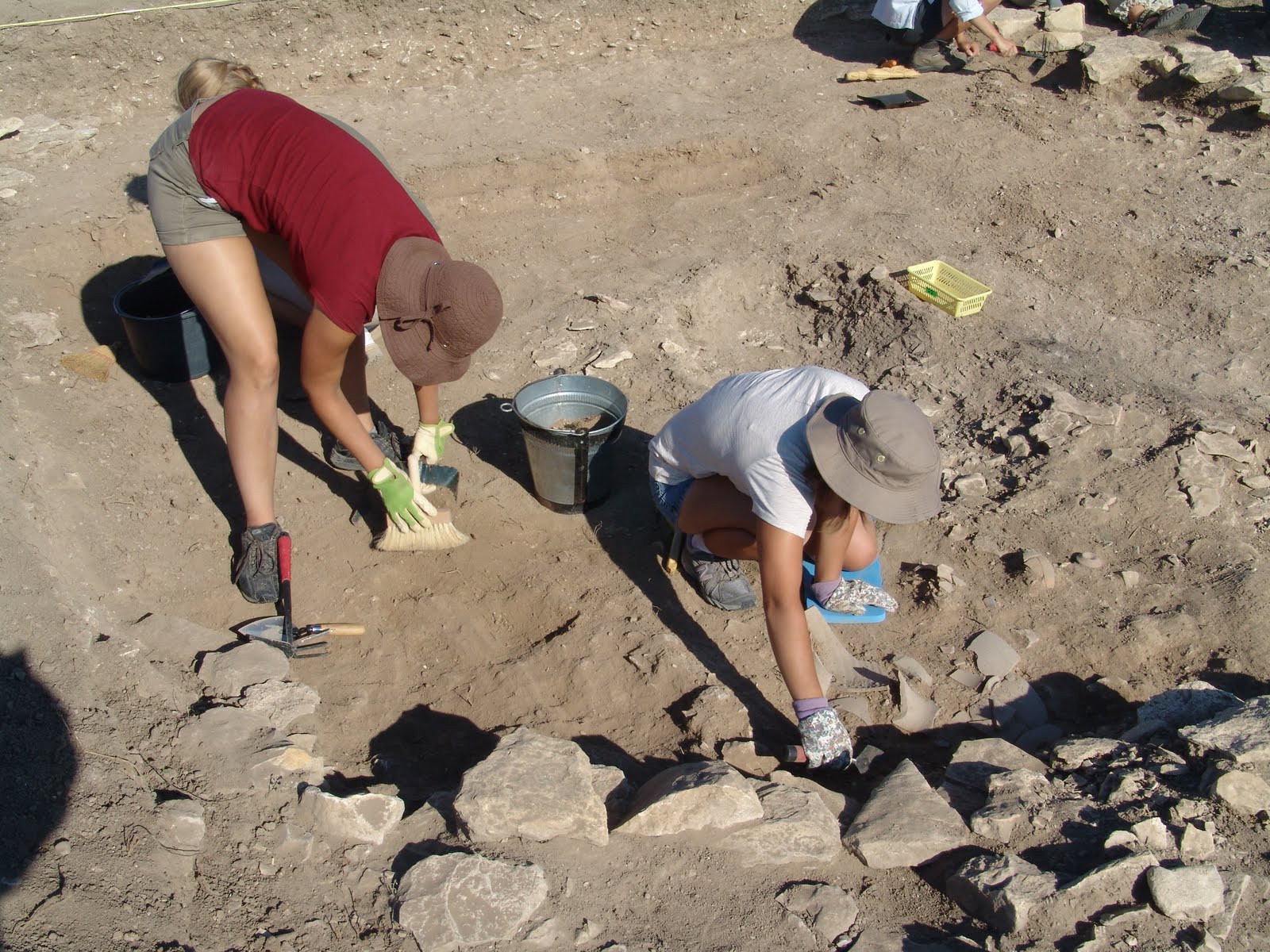
The 2011 season in the Orgame necropolis has been devoted to the excavation of a new family plot of several tombs identified at the western edge of the necropolis.

The archaeological team for the Orgame research programme is directed by Dr. Vasilica Lungu (representing both the Institute of South-East European Studies and the “Vasile Pârvan” Institute of Archaeology, Bucarest), and Dr. Alexandre Baralis (Centre Camille Jullian, Aix-en-Provence), head of the ANR programme “Pont-Euxin”, and is joined by graduate students Alexandra Dolea and Alina Musat (Faculty of History, University of Bucharest,).

A group of Canadian students participated in the 2011 field season, including Nicole Aszalos, Carolyn Clarke, Shelby Haggerty, Frances  Jardine, Thomas  Krol,  Anna  Laytner, Amanda  MacKinnon,  Sarah  Timmins, and Katherine  Tyka  under the guidance of Prof. Dr. Gerald Schaus from Wilfrid Laurier University (Waterloo, Ontario).

Also participating for shorter periods of time were, from “Babeș Bolyai” University (Cluj-Napoca) Dr. Carmen Rogobete with students Claudia Radu and Claudiu Barb and from Dunărea de Jos University (Galați), students Adina Gutu, Micu Simona and from the University of Bucharest, graduate students Marius Streinu and Theodor Zavalaş.


Note: The 2011 excavation season has received generous financial support from the French-Romanian project ANR –“Pont Euxin” 2010-2012; and from the Department of Archaeology and Classical Studies, Wilfrid Laurier University.


8/21/11

On the traces of the Ancient Greeks in the Black Sea: the Danube Delta

The Danube, called by Greeks "Istros", is known from ancient times as “the largest of the rivers of Europe...” (Aelian, On Animals 14. 23). It joins the Black Sea through the Delta, the second largest and best preserved in Europe. The name of the Danube Delta is also Greek in origin, deriving from its geographical shape similar to the Greek letter “delta”.
Described by Hesiod as the “beautifully flowing Istros” (Theogony, 339), this river is an open gate to Europe, as well as the confluence of many cultures and civilizations.
Today, because of the richness of its ecosystems and of the particular cultural heritage identified there, the Danube Delta became a UNESCO protected area in 1991.

The city of Orgame (called "Argamum" in Roman times) was placed by Hecataeus of Miletus on the Istros river (Orgame polis epi to Istro…., apud Stephan's of Byzantion, Ethnica, FGrHist I, fr. 172). Following I. Malkin's (2005) theory concerning the phenomenon of Greek colonial  settlements, that they are founded in places which create a web or net pattern within micro-regions, the site of Orgame could be considered as part of the Istros micro-region.
In order to study the role of this river in the life of the ancient Greek colony of Orgame, an archaeological excavation team, formed by professors and students from Romania and Canada working this year on the Greek necropolis of Orgame, organized a field trip on the Danube Delta on August 7th.